
Autism Support Austria
Our own prototype of a help directory for autistic people in Austria and their families: 40 offers from seven providers and 93 places to turn to in Austria, Germany and Switzerland, built between 10 and 12 October 2026.
Challenge
Support for autistic people and their families exists in Austria, but it is spread over many websites, and it is often hard to tell what an offer costs or how to sign up. We wanted to show what a calm, clear directory for this field can look like. Autism Support Austria is our own prototype, not a product we sell or run for anyone. We collected the content from the providers' public websites, and the site is in German.
What we built
The site has two layers. The first holds 40 offers from seven providers, and each answers the same questions in the same order: what it is, for whom, where, what it costs and how to sign up. The second is a directory of 93 places to turn to, from outpatient clinics to associations: 69 in Austria, with entries in all nine federal states, 14 in Germany and 10 in Switzerland.
Cost and sign-up are required fields in the TypeScript type for an offer, so an offer without them fails the type check. Where the provider's website states no cost, the entry says so and tells the reader to ask. In the directory, who pays stays unknown unless the official page states it, and the list then shows nothing rather than a guess: a wrong claim that health insurance pays does more harm than a gap. The gaps are large. Of the 93 directory entries, 76 say nothing about who pays, and for five of the 40 offers the provider's website states no cost. Every entry stores its source and has a link to report an error, which fills the entry's name into the contact form. Each report arrives as a plain e-mail and is fixed by hand.
Signing up often means calling within set hours, at one provider only on Monday from 16:00 to 17:00 or on Friday from 11:00 to 12:00. So every phone number is a tap-to-call button, and the sign-up line spells the hours out.
We wrote calm reading into the code, based on the UK Home Office guidance on designing for users on the autistic spectrum and on the rules for plain German. One stylesheet rule switches off every animation, transition and smooth scroll. The menu has five entries, the same on every page. Readers choose between three text sizes and between light and dark, stored in cookies, so the server renders the right version and the page never flashes the wrong one first. Our first design leaned on bordered cards and every element looked the same. We replaced it the same day with hairline lists, tiles for the entry points and numbered steps.
The map is an extra and never replaces the list. It runs MapLibre on our own tile server, without fly animation, rotation or tilt, and the mouse wheel zooms it only with Ctrl held, so scrolling down the page never zooms the map by accident. A script geocoded the addresses once, ahead of time, through the OpenStreetMap service Nominatim, so no reader's browser sends an address to a third party. The catch is that every changed address means running the script again. The first map, from 10 October, hid behind one error note whenever a MapLibre error mentioned the style. On 12 October we rebuilt it on the pattern of our LearnATC map: it checks for WebGL first and names each failure in plain words, next to the note that the list holds everything.
The content lives in typed TypeScript files in git, with no CMS and no database. About 130 entries can be reviewed in a diff and there is no admin login to secure, but every correction needs a developer, a commit and a deploy. The site tracks nothing and loads nothing from third-party servers. A noindex tag, a matching header and robots.txt ask search engines to leave it out until the content has been reviewed with the providers, because a directory that names real clinics should not show up in search before they have seen it. Together, these decisions leave us with no usage data and no search traffic, so we cannot say how readers use the site.
Stack
Nuxt 4 with Vue and TypeScript, rendered on the server, and Tailwind CSS 4 with UI components on reka-ui. Icons are bundled into the server and the typeface, Atkinson Hyperlegible Next, is self-hosted, so the page makes no requests to icon or font services. MapLibre GL draws the map from our own tile server with OpenStreetMap data, and the contact form sends mail through nodemailer and our own mail account. Like every project of ours it runs in Docker, behind nginx and Traefik, on our servers rented at Hetzner in Germany. There are no WebSockets: content that changes only when we edit it needs no live connection.
Result
Autism Support Austria is live at autism.blax.at as a prototype, built between 10 and 12 October 2026 and unchanged since, and that shows. All 93 directory entries still carry the check date 10 October 2026, and the list shows only a general note, as of October 2026, instead of each entry's date. Offers have no check date of their own at all. Of the 35 dates in the events list, 18 were still ahead on 27 November 2026, and the last one is in February 2027.
Three more weaknesses. The deploy build does not run the type check, so an offer without cost or sign-up would still go live. Coverage is uneven: of the 40 offers, 21 are in Vienna, 12 in Upper Austria, one in Vienna and Lower Austria and six cover all of Austria, so a reader in Tyrol who filters the offers sees only those six and has to switch to the directory. And the filter for free offers checks whether the cost text starts with the word Kostenlos, so the health hotline 1450, whose text says it is free later in the sentence, does not count as free. A separate yes or no field for free would fix that.
If you are building a directory, this carries over. Make the questions your readers need answered required fields, and let the build enforce them. Write that the source does not say instead of guessing, and expect many gaps. Store a source and a check date with every entry, show both, and plan the re-check from the first day. Typed data files in git are enough for about 130 entries and one maintainer. Once people who do not write code have to correct entries, a CMS or an editing workflow is worth setting up.
More case studies
All case studies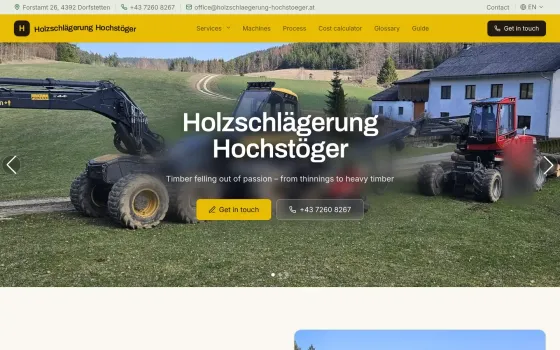
Website · three languages
Holzschlägerung Hochstöger
The website of Holzschlägerung Hochstöger, a forestry business in Dorfstetten. In German, English and Czech, with a cost calculator for forest owners.
Read the case study
Website · volunteer fire brigade
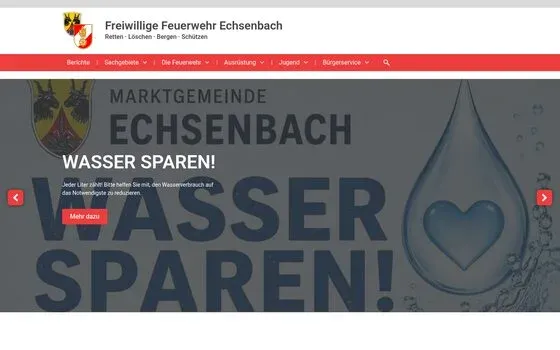
FF Echsenbach website
The website of the Freiwillige Feuerwehr Echsenbach. We moved 946 reports going back to 2004 into WordPress and handed the site to the brigade's team.
Read the case study
EduTech for student pilots
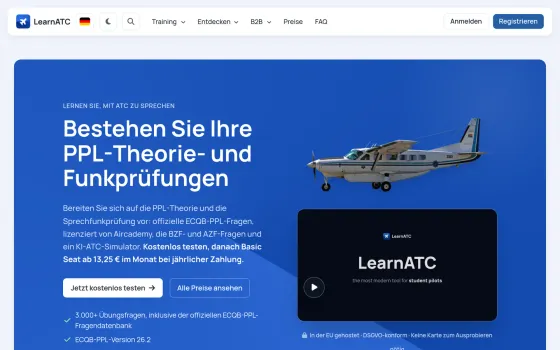
Learn ATC
Developed together with our joint-venture partner Clesk Digital: a training platform for student pilots that combines an AI air-traffic-control simulator with structured lessons and the official exam questions for the PPL theory and the radio exams.
Read the case study

Want something like this for your business?
Tell us what you need. We will get back to you within one business day.

You talk to Fabian Wagner, founder
No sales desk in between: he reads every enquiry himself.
Prefer a call? +•• ••• ••• •• ••